

FLD-103: An Investigational Non-Surgical Treatment for Basal Cell Carcinoma
Basal cell carcinoma (BCC) is the most common type of skin cancer. In North America, 4.3 million cases are diagnosed each year. BCC results from the uncontrolled growth of skin cells, primarily in areas of the body that have been exposed to the sun for extended periods. Patients affected by BCC commonly develop tumors on the face, neck, scalp, and arms, which are areas that are often highly visible and cosmetically sensitive. Additionally, patients with BCC are at a higher risk of developing new or multiple lesions.
The standard treatment for BCC is surgical removal or excision. While non-surgical treatments exist, they are not indicated for all types of BCC and can lead to side effects. As a result, many patients undergo surgery, which may require extended procedural time, local wound care, and a recovery period. Cosmetic changes to the treated skin, including scarring or discoloration, may occur. Some patients require multiple procedures over time depending on disease recurrence or the number of lesions treated. This underscores continued interest in evaluating additional treatment approaches for patients with BCC.
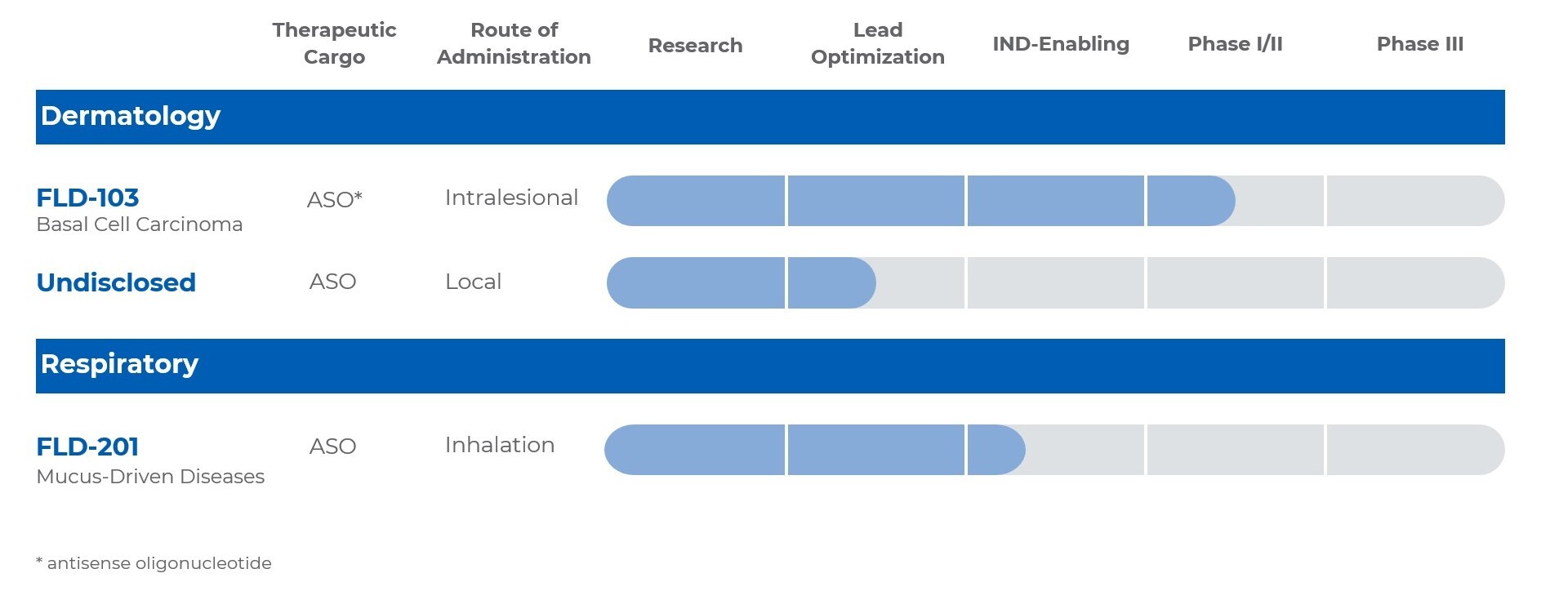
Feldan Therapeutics is developing FLD-103, an investigational non-surgical approach to treat nodular BCC, the most common subtype of the disease. This treatment, injected directly into the tumor, is intended to selectively target BCC cells by disrupting an intracellular component involved in the pathophysiology of the disease, with the aim of preserving surrounding healthy tissue and supporting cosmetically favorable outcomes.
FLD-103 is currently being investigated in a Phase 1 clinical study to evaluate its safety, tolerability and exploratory efficacy.
FLD-103 Clinical Trial Status
FLD-103 is an investigational treatment currently being evaluated in a Phase 1 clinical trial and has not yet been approved for general use.
The Phase 1 clinical trial of FLD-103 is being conducted across multiple sites in the United States and Australia. In Australia, the trial is overseen by Feldan’s wholly owned subsidiary, Feldan Australia Pty Ltd.
FLD-201: An Investigational Inhaled Therapy Targeting Mucus Overproduction in Mucus-Driven Lung Diseases
Mucus-driven lung diseases (MDD) encompass a broad range of chronic respiratory conditions characterized by excessive and abnormal mucus production, including non-cystic fibrosis bronchiectasis (NCFB) and chronic bronchitis (CB). In these diseases, mucus is a central pathological driver of airway obstruction, recurrent infections, chronic cough, and progressive loss of lung function. The resulting disease burden places a sustained impact on patients’ daily lives and long-term respiratory health.
In NCFB, more than 80% of patients report excessive mucus production as their most debilitating daily symptom (Aliberti et al., 2016), associated with frequent exacerbations that accelerate disease progression. Despite available therapies for NCFB and CB, patients often continue to exhibit pathological mucus hypersecretion, as the underlying driver of mucus overproduction remain unaddressed.
FLD-201 is an inhaled investigational therapy being developed by Feldan. It is designed to target a key driver of pathologic mucus hypersecretion in Mucus driven diseases, including NCFB and CB, with the aim of reducing excessive mucus production and disrupting the cycle of infection and inflammation. Currently in preclinical development, FLD-201 has demonstrated target engagement and improvements in mucus-related endpoints across relevant models.