



Touche ≈ 4,3 millions de personnes
chaque année en Amérique du Nord

Principalement causé par
une exposition répétée au soleil

Se développe le plus souvent sur les zones
exposées au soleil comme le visage,
le cou et le cuir chevelu

Bien que la chirurgie soit le traitement standard,
il existe un besoin de traitements permettant
de préserver la peau, de minimiser l’inconfort et
de favoriser un retour rapide aux activités
quotidiennes des patients
Types de CBC et traitements
Les carcinomes basocellulaires débutent dans la couche basale de la peau et peuvent se présenter sous différentes formes, selon leur mode de croissance au sein des couches cutanées.
CBC superficiel (≈15 % des cas)
Généralement traité par des médicaments topiques, tels que des crèmes, appliqués directement sur la peau.
CBC avancé ou métastatique (≈1-10 % des cas)
Traité par des thérapies systémiques, telles que des inhibiteurs de la voie Hedgehog, ou par chirurgie.
CBC nodulaire (≈60-80 % des cas)
Ce type évolue lentement, n’est pas agressif et se métastase rarement. Toutefois, en l’absence de prise en charge, il peut entraîner une destruction locale des tissus et de l’os. Il est le plus souvent traité par excision chirurgicale, notamment par la chirurgie de Mohs, souvent considérée comme le traitement de référence.
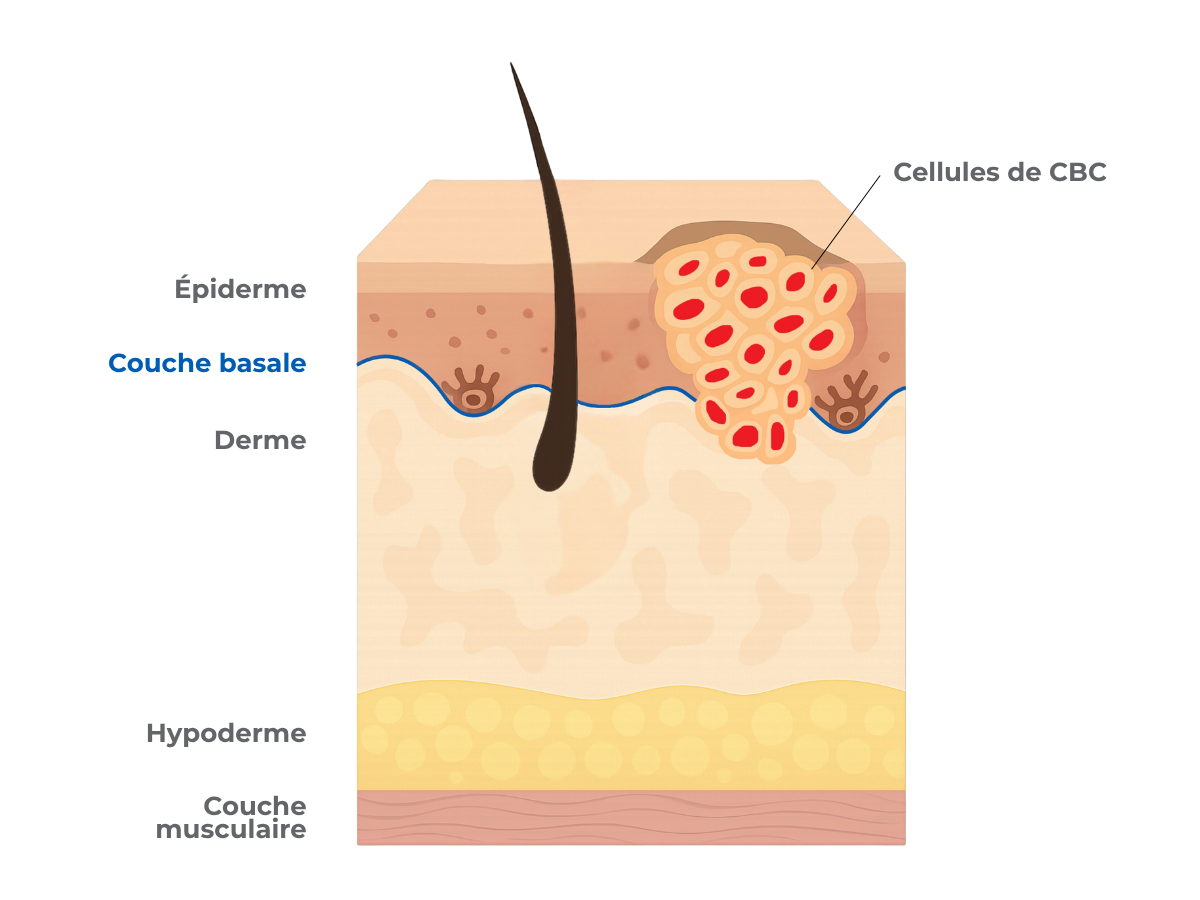
Comprendre la prise en charge du CBC nodulaire
Bien que la chirurgie de Mohs soit très efficace et demeure une approche thérapeutique de référence, il s’agit d’une intervention chirurgicale pouvant nécessiter un temps opératoire important, des soins locaux de la plaie et une période de récupération. Des modifications de l’apparence de la peau traitée, notamment des cicatrices ou des changements de pigmentation, peuvent survenir. Certains patients peuvent nécessiter plusieurs interventions au fil du temps, selon la récidive de la maladie ou le nombre de lésions traitées.
Cela souligne la nécessité d’évaluer des approches thérapeutiques additionnelles pour les patients atteints de CBC nodulaires.


_FR.png?width=1500&height=720&name=FLD-103%20MoA%20Simplified%20(Patients)_FR.png "FLD-103 MoA Simplified (Patients)_FR")